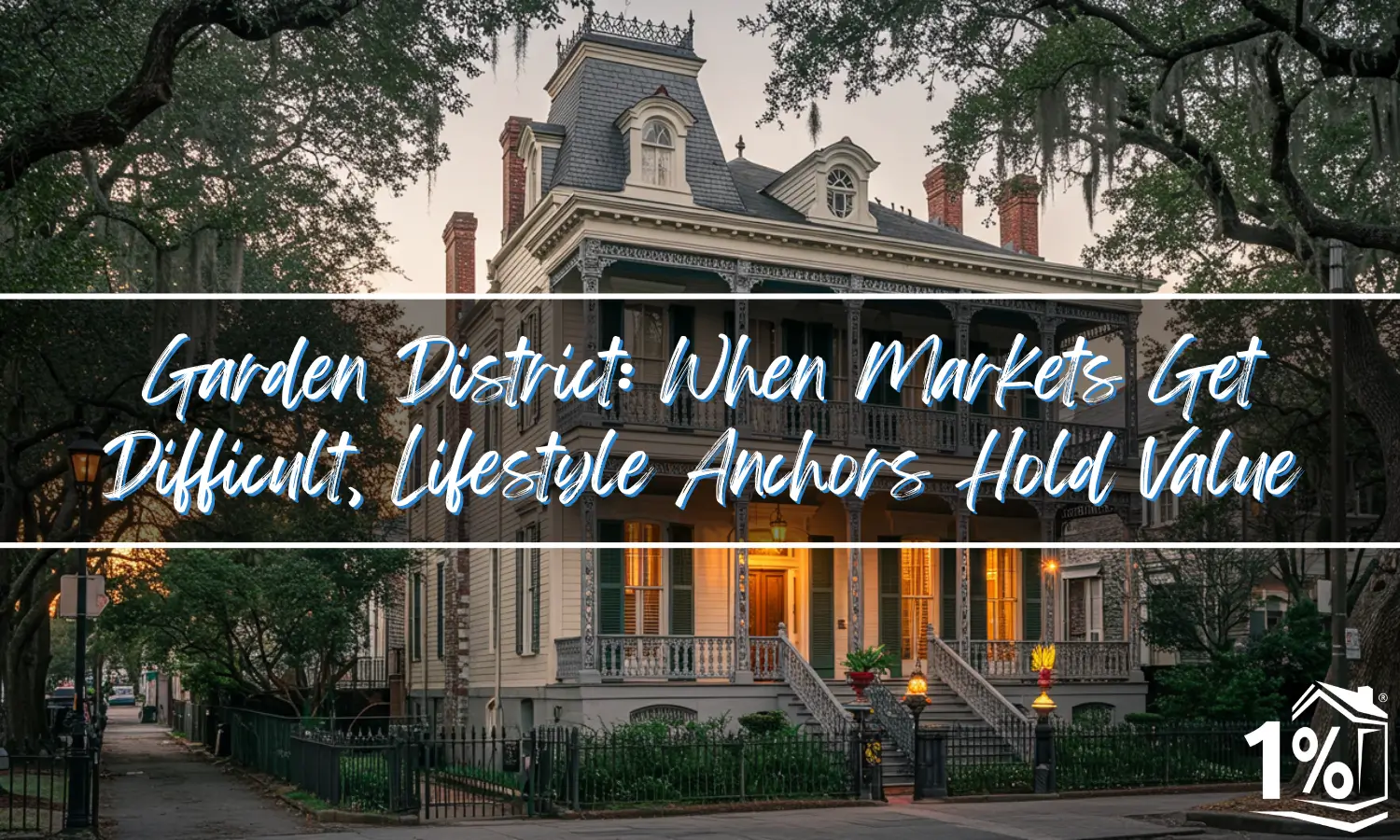
When John Goodman’s Garden District mansion went under contract this month after a $700,000 price reduction, it wasn’t a story about market weakness – it was proof that Garden District’s lifestyle anchors hold value even when everything else gets complicated. The beloved actor’s 1850s historic home dropped from $5.45M to $4.75M, but here’s the telling part: it still sold, and Goodman isn’t leaving New Orleans. He’s staying in the city that’s been his anchor for 30 years, just downsizing.
In today’s unpredictable market, that kind of loyalty tells you everything about what makes Garden District different. While other luxury markets chase trends, the Garden District offers something that can’t be replicated: 175 years of proven staying power.
Why Garden District Works When Markets Don’t
Historic Preservation Creates Stability
The numbers tell a compelling story about resilience. Garden District homes range from $489,000 median to over $5 million, but here’s what agents don’t emphasize: this is a National Historic Landmark district with the kind of architectural protection that creates long-term value stability.
According to the Garden District Association, the area achieved Local Historic District status in 2007, giving the Historic District Landmarks Commission jurisdiction over new construction and demolition. This isn’t just bureaucratic red tape – it’s value protection. When markets get volatile, architectural integrity becomes an anchor.
The Preservation Resource Center notes that Garden District represents “one of the best-preserved collections of historic mansions in the Southern United States,” developed between 1832 and 1900. You’re not just buying a house; you’re investing in 175 years of architectural evolution that’s legally protected from destruction.
Magazine Street: The Lifestyle Infrastructure That Doesn’t Disappear
Here’s why Garden District weathers market uncertainty better than newer luxury developments: Magazine Street. This isn’t some developer’s promise of future retail – it’s a 2.5-mile established corridor of boutiques, restaurants, and local businesses that has served the neighborhood since the 1800s.
When economic uncertainty hits, lifestyle amenities built over decades don’t vanish like developer promises. Magazine Street’s walkable shopping and dining survived the Civil War, the Great Depression, Hurricane Katrina, and every market downturn since 1832. That’s the kind of infrastructure permanence you can’t get in suburban developments.
The St. Charles Streetcar: Permanent Transportation Infrastructure
Unlike communities dependent on highway access or traffic patterns, Garden District benefits from the St. Charles streetcar line – operational since 1835 and still running. This isn’t just charming transportation; it’s a dedicated transit line that connects you to downtown New Orleans regardless of traffic, construction, or city planning changes.
In uncertain times, having transportation infrastructure that’s survived 190 years provides a stability that new developments simply can’t offer.
Real Market Data: What Garden District Numbers Actually Show
Current market data reveals why lifestyle permanence matters more than short-term pricing:
Market Reality (August 2025):
- Median home price: $652,000 (June 2025 data)
- Days on market: 91 days (vs. 101 days last year)
- Price trends: Down 12.4% year-over-year, but sales still happening
- Average sale price: $1,037,571 (showing luxury market activity)
What This Really Means: Smart buyers are finding opportunities in a market that’s correcting from artificially high prices. Garden District’s fundamentals – historic protection, established infrastructure, cultural significance – remain intact while pricing becomes more realistic.
Our commission savings approach becomes especially valuable when buyers need every advantage in a selective market.
Why Established Beats “Exclusive” Every Time
Garden District offers something that gated suburbs can’t: authentic community integration. You’re not buying into an artificial environment maintained by HOA fees. You’re joining a neighborhood that’s been functioning as a community for nearly two centuries.
Community Infrastructure That Works:
- Lafayette Cemetery No. 1 – Historic landmark providing green space and cultural significance
- Commander’s Palace – Legendary restaurant that anchors fine dining culture
- Historic home tours – Established tourism infrastructure that supports property values
- St. Charles Avenue parades – Mardi Gras tradition that brings the community together annually
Compare this to newer luxury developments where community amenities depend on developer maintenance and HOA management. Garden District’s lifestyle infrastructure is embedded in the neighborhood’s historic fabric.
Commission Savings Reality Check in a Difficult Market
When markets get selective, commission savings become crucial for competitive positioning:
The Traditional Agent Math:
- $652,000 home purchase (Garden District median)
- 6% total commission (3% buyer agent + 3% seller agent)
- You indirectly pay: $39,120 in commissions
The 1 Percent Lists Math:
- Same $652,000 home
- 1% listing commission + standard buyer agent cooperation
- You save: $19,560
What $19,560 Provides in Garden District:
- Historic home restoration and period-appropriate renovations
- Landscape improvements for authentic garden appeal
- Reserve fund for ongoing historic home maintenance
- Or simply better negotiating position in a buyer’s market
Investment Logic: Why Historic Neighborhoods Weather Uncertainty
Garden District’s investment case isn’t about short-term appreciation – it’s about long-term stability through permanence:
- Architectural Protection: Historic designation prevents inappropriate development that could harm property values
- Cultural Significance: Tourism and cultural importance provide economic anchoring beyond residential real estate
- Infrastructure Maturity: All utilities, transportation, and community services fully established and maintained
- Geographic Limitations: Bounded area prevents oversupply that damages newer developments
For more context on luxury market dynamics, consider how established neighborhoods compare to speculative developments during market uncertainty.

Ready to Explore Garden District’s Stability Advantage?
While other agents chase market trends and promote speculative developments, we focus on neighborhoods with proven staying power. Our 1% commission approach means more money in your pocket for the kinds of homes that hold value regardless of market conditions.
Want to see current Garden District opportunities with realistic market analysis? Contact us for a consultation focused on historic value, lifestyle permanence, and smart buying in uncertain times. Read our client reviews to see how we’ve helped buyers find stability and value in New Orleans’ most enduring neighborhoods.
This analysis is based on publicly available data from official historic preservation sources, MLS information, and current market data. Individual property details, landmark designations, and investment performance may vary. All commission calculations assume standard market conditions and successful closings.